According to Fannie Mae, 90% of buyers don’t actually know what credit score lenders are looking for, or they overestimate the minimum needed.
Let that sink in. That means most homebuyers think they need better credit than they actually do – and maybe you’re one of them. And that could make you think buying a home is out of reach for you right now, even if that’s not necessarily true. So, let’s look at what the data really says about credit scores and homebuying.
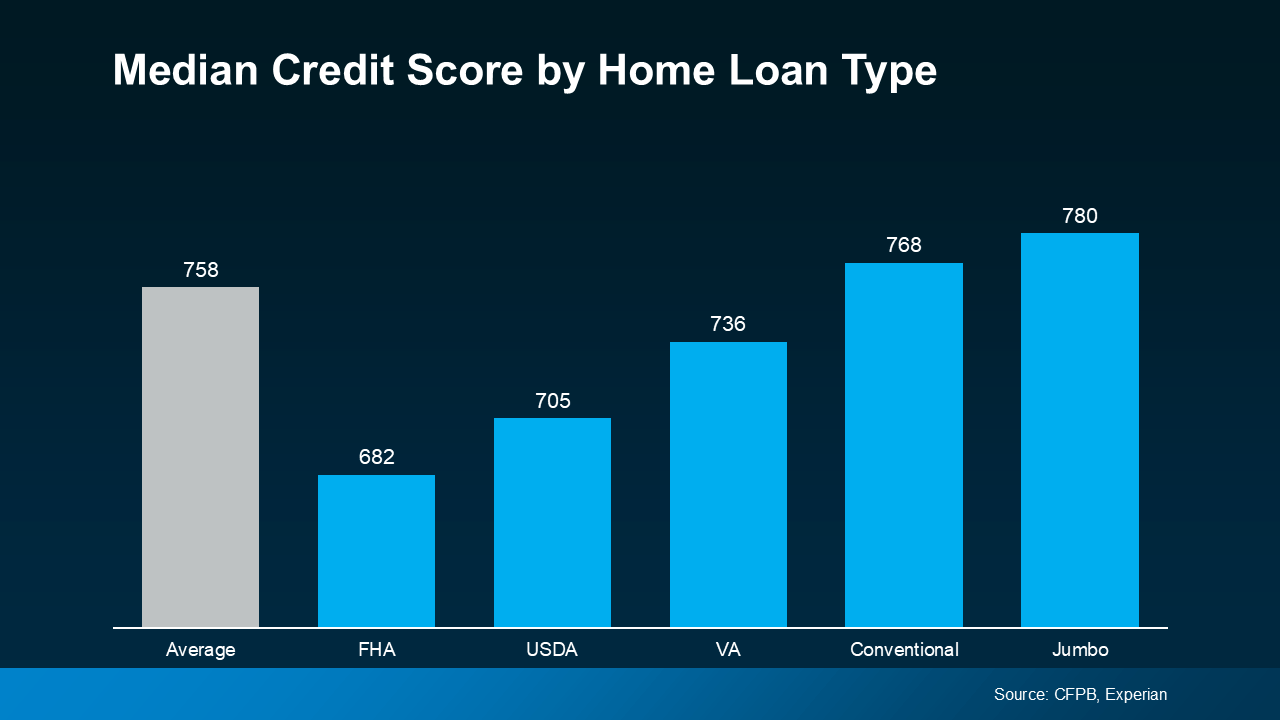
There’s no universal credit score you absolutely have to have when buying a home. And that means there’s more flexibility than most people realize. Check out this graph showing the median credit scores recent buyers had among different home loan types:
Here's what’s important to realize. The numbers vary, and there’s no one-size-fits-all threshold. And that could open doors you thought were closed for you. The best way to learn more is to talk to a trusted lender. As FICO explains:
“While many lenders use credit scores like FICO Scores to help them make lending decisions, each lender has its own strategy, including the level of risk it finds acceptable. There is no single ‘cutoff score’ used by all lenders, and there are many additional factors that lenders may use . . .”
When you buy a home, lenders use your credit score to get a sense of how reliable you are with money. They want to see if you typically make payments on time, pay back debts, and more.
Your score can impact which loan types you may qualify for, the terms on those loans, and even your mortgage rate. And since mortgage rates are a big factor in how much house you’ll be able to afford, that may make your score feel even more important today. As Bankrate says:
“Your credit score is one of the most important factors lenders consider when you apply for a mortgage. Not just to qualify for the loan itself, but for the conditions: Typically, the higher your score, the lower the interest rates and better terms you’ll qualify for.”
That still doesn’t mean your credit has to be perfect. Even if your credit score isn’t as high as you’d like, you may still be able to get a home loan.
And if you talk to a lender and decide you want to improve your score (and hopefully your loan type and terms too), here are a few smart moves according to the Federal Reserve Board:
Your credit score doesn’t have to be perfect to qualify for a home loan. But a better score can help you get better terms on your home loan. The best way to know where you stand and your options for a mortgage is to connect with a trusted lender.
Check out the latest articles on real estate trends.

Lifestyle
Discover Atlanta's newest arts and culture event featuring more than 125 artists, food trucks, live entertainment, and community activities at Galleria in the Park.

Lifestyle
Discover why the Grant Park Summer Shade Festival continues to attract thousands of visitors each year and explore the unique lifestyle that makes Grant Park one of Atlanta's most recognizable neighborhoods.

Lifestyle
A look at Atlanta's iconic stadium and what visitors can expect during one of the biggest international soccer events ever hosted in North America.

Lifestyle
Discover how you can view planets, stars, and distant galaxies for free at Fernbank Science Center in Atlanta.


Lifestyle
Experience family fun, live entertainment, cultural celebrations, community vendors, and a spectacular fireworks tribute during Atlanta's Juneteenth Festival weekend.

Lifestyle
Discover why the Watermelon Capital of the World hosts one of Georgia's most unique summer festivals, located just 2 hours from Atlanta.

More than 30 local vendors, international cuisine, and a pedestrian-friendly experience are coming to Walton Street from June 11 through July 15.
Lifestyle
Metro Atlanta shoppers are getting a new Trader Joe's, bringing more convenience, unique products, and another exciting retail addition to the region.
Address
3107 Peachtree Rd NE A-1
Atlanta GA 30305